
Hancock County Criminal Court Cases
Hancock County divides criminal work by court level. General Sessions Court handles most misdemeanors, warrants, initial appearances, and preliminary hearings in felony accusations. When a grand jury returns an indictment, the felony proceeds in Circuit Court within Tennessee's Third Judicial District. A misdemeanor can stay in General Sessions through plea or trial. Sneedville City Court has a narrower role for city ordinance and municipal matters. It does not replace either county court.
The Circuit Court Clerk is the practical records gateway for Hancock County Circuit and commonly General Sessions files. The clerk preserves minutes, rule and execution dockets, indexes, appellate papers, and financial entries. The Tennessee Courts listing for Hancock County confirms the local Circuit, Criminal, and Chancery court location. That official listing appears in the image below.
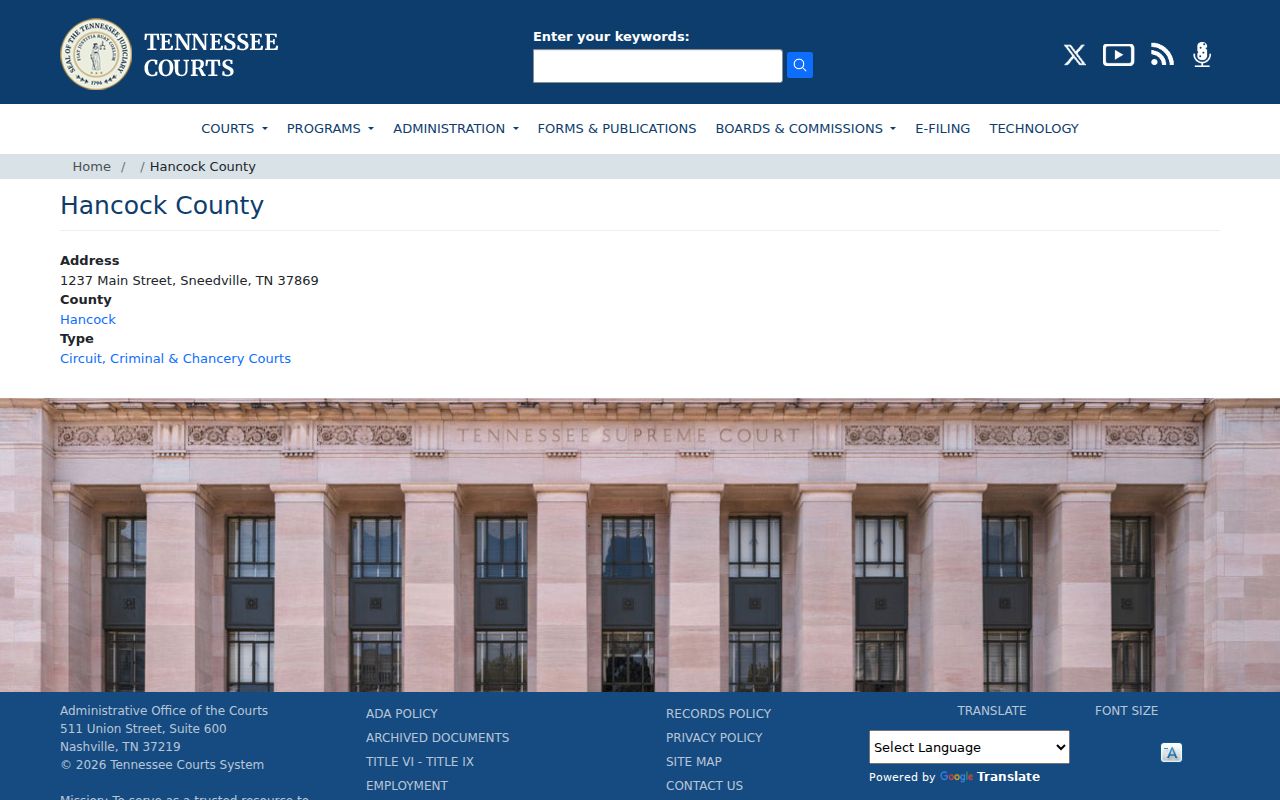
The image helps confirm which Hancock County court office holds the trial-level case rather than a jail or state repository record.
Hancock County Court Levels Compared
A single prosecution can leave entries at more than one level. The first Sessions number may track a complaint, bond review, appointed counsel, and a preliminary hearing. A later Circuit number can begin with the indictment. Asking for only one number risks finding half of the public story.
Sneedville City Court is separate. Its clerk can address municipal matters within that court's jurisdiction, while the Hancock County Circuit Court Clerk handles the county criminal docket. Appeals take another route. Tennessee offers an appellate case search, but that resource does not supply a complete free name search of Hancock County trial files.
| Court | Typical criminal role | Records contact |
|---|---|---|
| General Sessions | Misdemeanors, warrants, first appearances, felony preliminaries | Circuit Court Clerk, 423-733-2954 |
| Circuit Court | Indicted felonies, judgments, sentences, later case events | Micah Wallen, 1237 Main Street |
| Sneedville City Court | City ordinance and municipal matters | City Court Clerk, 423-733-2254 |
| Appellate courts | Appeals from trial courts | Tennessee appellate case search |
Searching Hancock County Case Records
No public Hancock County portal supplies a complete criminal name search. Start by calling the clerk and give enough detail to distinguish the right person and file. Ask staff to check both General Sessions and Circuit when a felony may have moved after its preliminary stage. A phone response helps locate an index entry, but only the filed docket or certified disposition documents the court's result.
- Call the Circuit Court Clerk at 423-733-2954 and state whether the request concerns General Sessions, Circuit, or both.
- Give the full legal name, an approximate filing year, and the docket number when known.
- Ask for the register of actions or docket sheet first, including any Sessions and Circuit cross-reference.
- Identify the charging paper, plea, judgment, sentencing order, and later revocation or expungement entries needed.
- Confirm whether the file is on site and request a current quote for plain or certified copies before ordering.
The table below is a request checklist for the clerk, not an online form. Hancock County has not published a self-service trial-court search interface.
| Lookup detail | Format | Needed? | Why it helps |
|---|---|---|---|
| Full legal name | Text | Yes | Primary party index term |
| Case number | Docket number | If known | Fastest file locator |
| Approximate filing year | Year | Recommended | Narrows paper and archived indexes |
| Court level | Sessions or Circuit | Recommended | Separates the early file from an indictment |
| Document type | Written description | For copies | Distinguishes docket, judgment, and certification needs |
Note: Confirm current copy fees, payment methods, and counter hours before visiting because Hancock County posts no criminal-copy fee schedule.
Hancock County Criminal File Counter
The clerk's office is at 1237 Main Street in Sneedville, with a P.O. Box 347 mailing address. Published counter hours are Monday through Friday, 8:00 a.m. to 4:00 p.m. Circuit Court Clerk Micah Wallen is assisted by deputy clerks Kayla Ferguson and Staci Humphreys Gibson. Call before travel to learn whether an older Hancock County criminal case remains in the active office or has moved to storage.
The official Hancock County Circuit Court Clerk page shows the local counter information captured here.
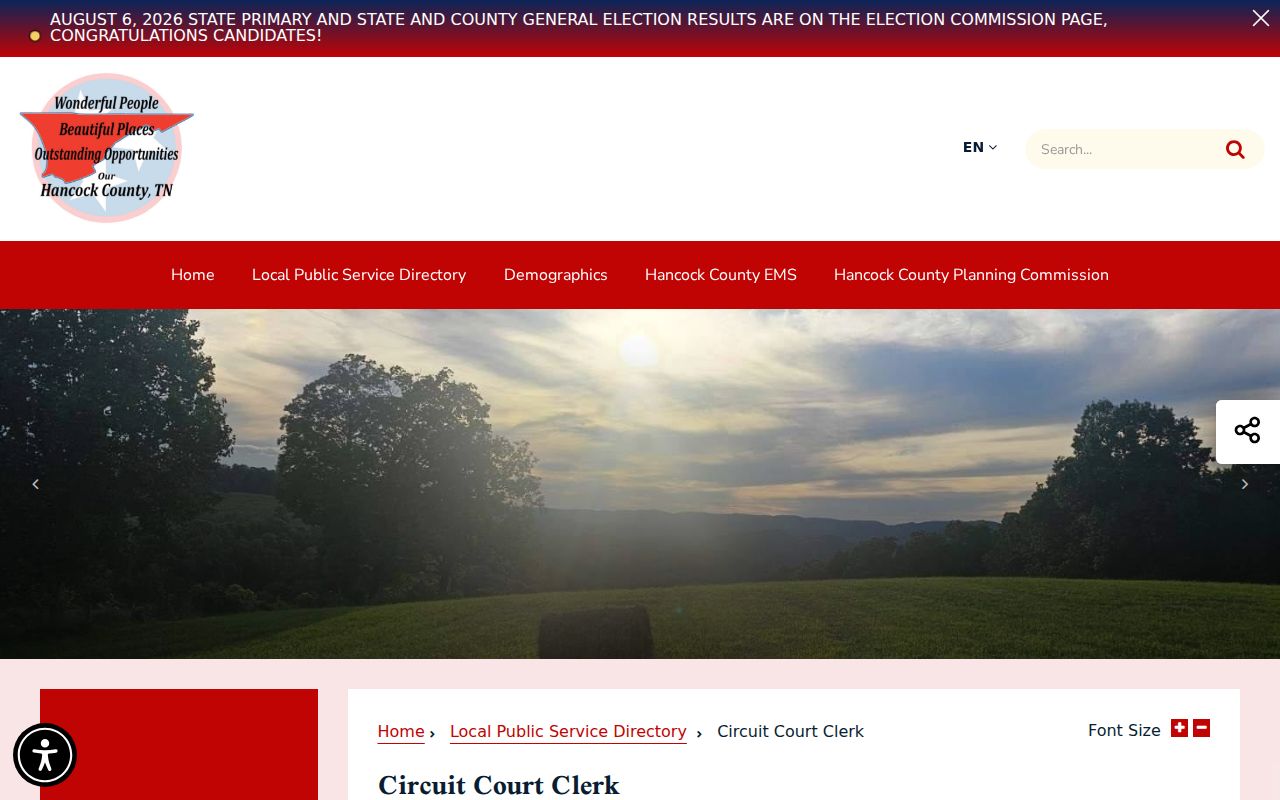
This office is the right starting point for docket sheets, indictments, judgments, and certified dispositions, not the County Clerk who handles vehicle and marriage services.
Hancock County Circuit Court Clerk
1237 Main Street
P.O. Box 347
Sneedville, TN 37869
423-733-2954
micah.wallen@tncourts.gov
Monday through Friday, 8:00 a.m. to 4:00 p.m.
Inside a Hancock County Case File
A court case file records the formal prosecution, not merely the arrest. Read the charging document and the final judgment together. A complaint may state the first accusation, an indictment may alter or replace counts, and the judgment shows the offense the court actually resolved. Docket entries connect those papers through hearings, motions, pleas, trial events, and sentencing.
| Case Number and Court | Shows the docket identifier, court level, and any Sessions-to-Circuit cross-reference. |
|---|---|
| Charging Document | May be a complaint, information, or indictment with offense text and statutory citations. |
| Docket Entries | Lists filed papers and events such as warrants, hearings, motions, pleas, and capias orders. |
| Hearing Dates | Records scheduled appearances, courtroom information, and event status where maintained. |
| Disposition and Judgment | Shows dismissal, acquittal, conviction, nolle prosequi, or another formal result by count. |
| Sentence and Conditions | Can list confinement, probation, fines, costs, restitution, and later violation proceedings. |
Protected identifiers do not belong in the public view. Social Security numbers, account data, juvenile details, protected victim information, and sealed matter may be removed or withheld even when the rest of a Hancock County case file is open.
Archived Hancock County Court Records
An empty web search does not prove that no Hancock County criminal case exists. Tennessee has no comprehensive free statewide trial-court name portal, and local files may be paper, scanned, archived, misspelled in an index, or listed under a different court number. Ask what years the clerk can search, where older boxes are stored, and whether a written request is needed.
If the file includes an expungement question, use the current Tennessee court forms collection and ask the Hancock County clerk for local filing instructions. The official forms index shown below is a source for current state forms, not a substitute for the case docket.
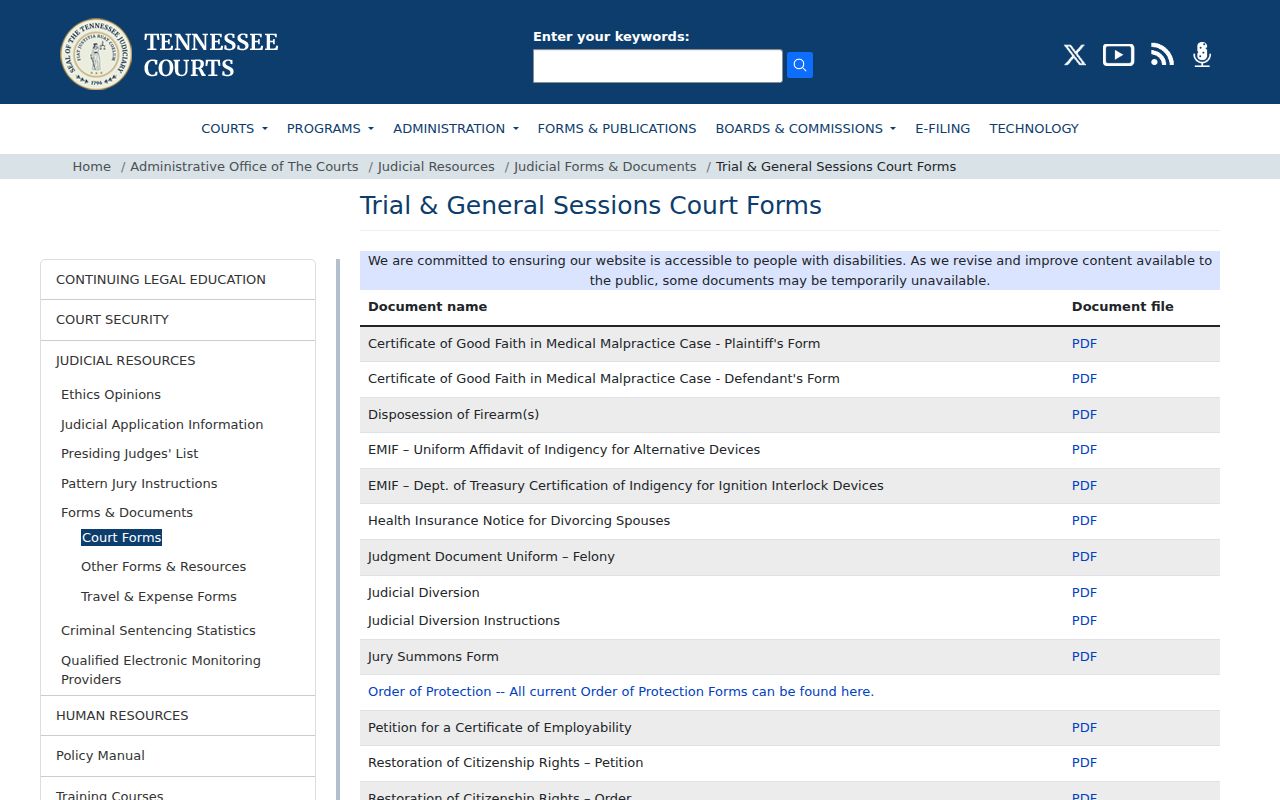
The clerk can identify the court that entered the disposition and whether the record includes a later expungement order.
How a Criminal Case Moves
After an arrest, a prompt initial appearance addresses the charge, rights, counsel, and release terms. Most misdemeanor matters can remain in General Sessions. For a felony accusation, Sessions may hold a preliminary hearing on probable cause. A grand jury then may return a true bill, which becomes an indictment, or a no true bill, which declines to indict.
An indicted Hancock County criminal case proceeds to Circuit Court for arraignment, discovery, motions, a negotiated plea or trial, judgment, and sentencing. An appeal creates an appellate docket, though the original trial papers remain local. Since the listed charge can change at several steps, the final disposition count is the sound source for describing the result.
The Third Judicial District prosecutor reviews charges, presents eligible matters to the grand jury, and represents Tennessee in Sessions and Circuit proceedings. The clerk, rather than the prosecutor, maintains the public case papers and records the disposition that later reporting sends to TBI.
Case flow: Charges Filed → Arraignment → Pretrial → Plea or Trial → Disposition → Sentencing
Hancock County's District Court Bench
Hancock County shares Tennessee's Third Judicial District with Greene, Hamblen, and Hawkins counties. That regional structure matters when a court date or assigned judge changes, but the local clerk remains the stable contact for the Hancock County criminal case file and its schedule entries.
A March 9, 2026 court notice opened a Circuit Court vacancy process after Judge William E. Phillips II moved to the Court of Appeals. The notice documents a district bench transition, not a change in the record custodian. Confirm the assigned judge and hearing date from the current docket rather than relying on an older directory or notice.
Reading Hancock County Docket Events
Short court terms can obscure what happened. A docket entry marks an event, while the filed order supplies its full legal effect. Never assume that “disposed” means convicted. It means the court entered an outcome, which could also be dismissal or acquittal.
- Disposition
- The outcome of a charge, such as conviction, dismissal, acquittal, or nolle prosequi.
- True bill
- A grand jury decision that supports an indictment and lets a felony prosecution move forward.
- Capias
- A court order directing that a person be taken into custody, often after a missed required event.
- Nolle prosequi
- The prosecutor's formal choice not to continue a charge at that time.
- Judicial diversion
- A Tennessee process that defers judgment and can lead to dismissal and possible expungement after successful completion.
For any Hancock County court case, pair a code or short entry with the signed order. A booking accusation, grand jury count, plea count, and judgment count can differ without any record being false. Tennessee entries may also use FEL A through E or MISD A through C. Those labels identify an offense class, while the judgment supplies the final conviction class and sentence.
Federal Cases Beyond Hancock County
Federal criminal cases arising in Hancock County belong to the U.S. District Court for the Eastern District of Tennessee. They do not appear as local Circuit Court prosecutions. The Eastern District court site provides the federal court gateway captured below.
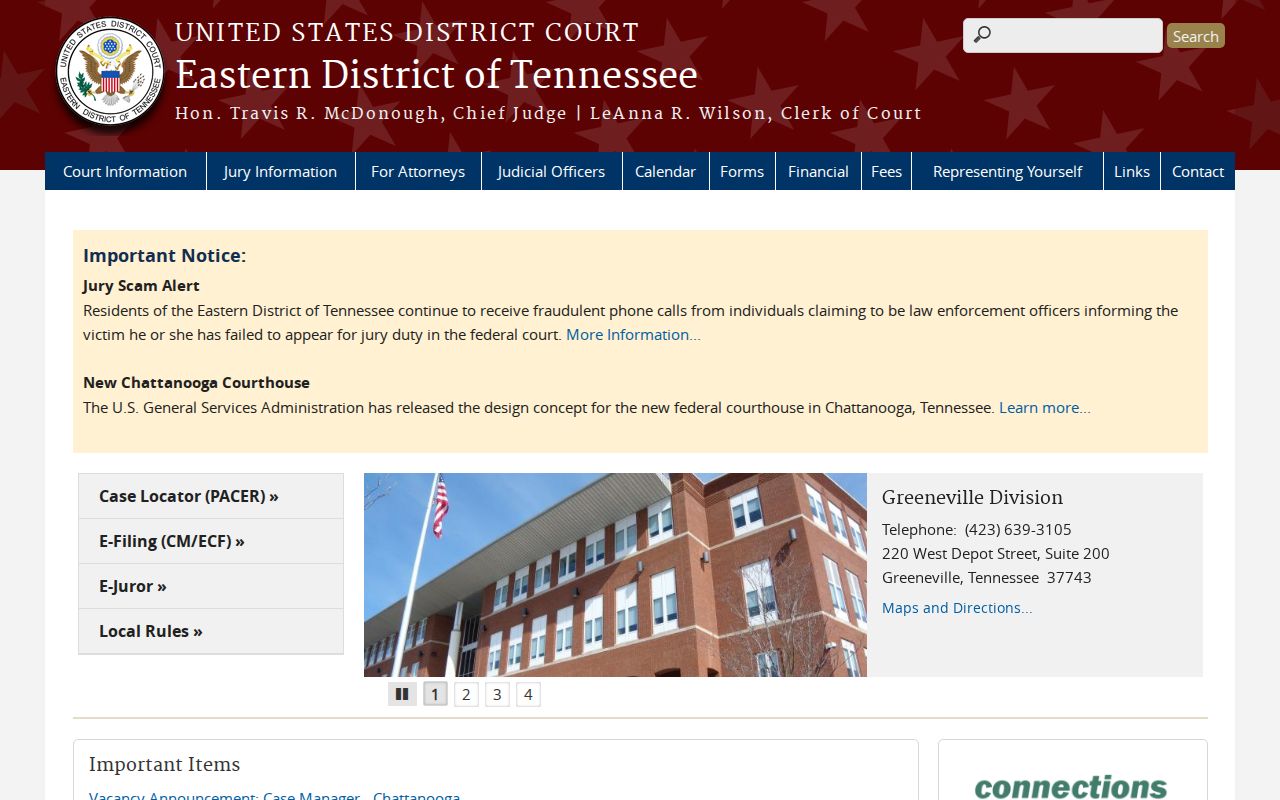
The federal clerk handles paper and certified federal records, while local Hancock County clerks remain custodians of state trial files.
Electronic federal dockets are available through PACER, which requires an account and can charge usage fees under its current schedule. The PACER access page is shown here.
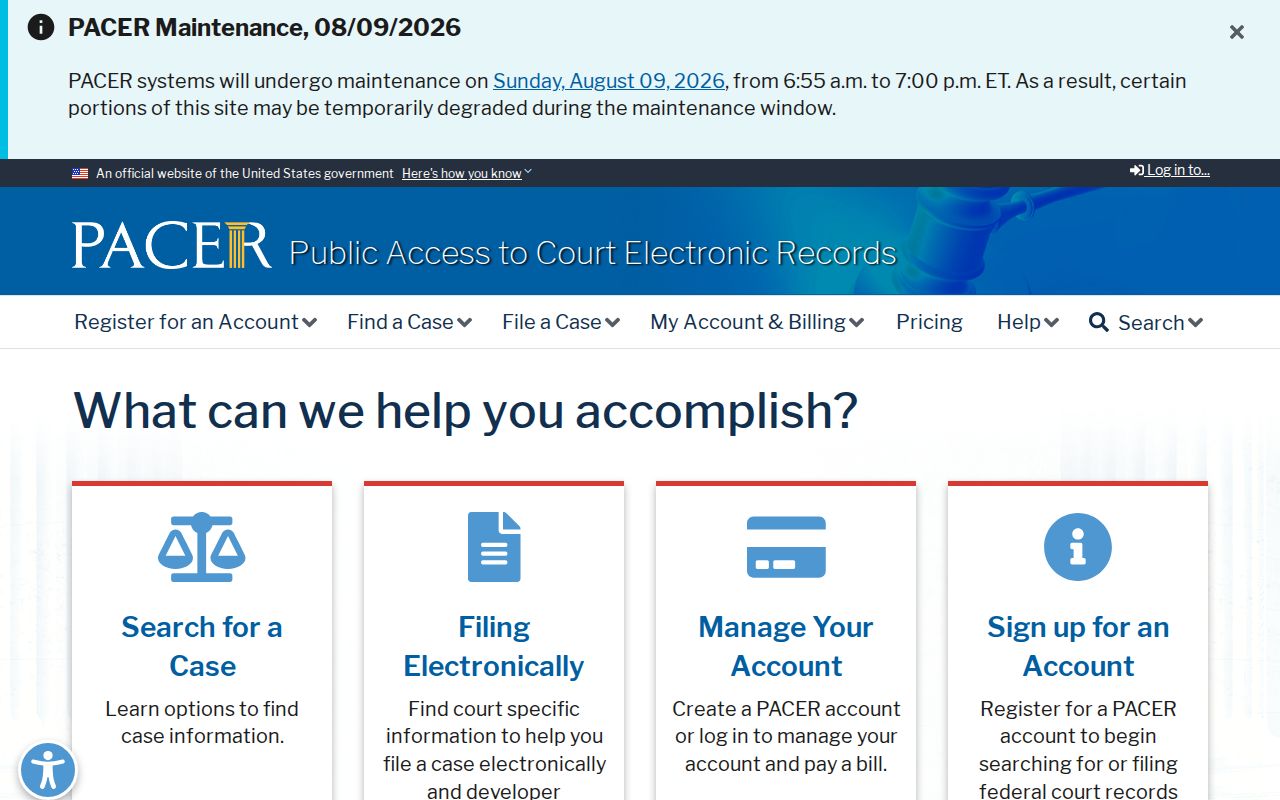
PACER is useful only for the federal layer. It does not replace the Hancock County Circuit Court Clerk's name and docket search.
Case Record Access & Restrictions
Tennessee Supreme Court Rule 34 treats court records as presumptively open, subject to court procedures, confidentiality law, and sealing orders. The Tennessee Public Records Act also supports access to state and local public records for Tennessee citizens unless another law makes the material confidential. Those rules do not make every line of every Hancock County criminal file public.
Access rules: Tennessee Supreme Court Rule 34 governs court-record access. T.C.A. §§10-7-503 and 10-7-504 cover public access and protected categories.
Juvenile matters, sealed or expunged records, protected victim and minor data, account numbers, and other confidential identifiers may be unavailable or redacted. If a case does not appear, ask the clerk whether it is archived, indexed under another number, confidential, or removed after an order. The wider Hancock County criminal history overview explains how a court file differs from a TBI repository result.
A certified disposition is the safer choice when the exact court outcome matters. Statewide repository records can lag, and a name match can join the wrong identity. Compare the signed Hancock County judgment with the docket history before drawing a conclusion.